
It is 9pm. A WhatsApp pings: “Can you price up Mexico for half term?” You know that message means three hours of research, and the client may never book.
So how should travel agents use AI? Not by replacing themselves with a chatbot. The smart approach is to hand the repetitive research and admin to a tool built for travel. That frees you for what clients actually pay you for: judgement, reassurance and insider knowledge.
This guide follows the whole client journey, stage by stage. It starts with that first enquiry and ends with a happy client rebooking and referring their sister. You will find practical steps, pitfalls to avoid and a checklist you can act on this week.
Who This Is For
This guide is for independent travel agents, homeworkers and small agency owners selling leisure holidays. You might be franchised, part of a consortium or fully independent. You might work alone or run a team of three.
Either way, you are the one answering messages at 9pm and chasing suppliers between school runs. You sell on service and trust, not on being the cheapest link on a comparison site. If you are curious about AI but sceptical of hype, this is for you.
The Real Problem: Hours Lost to Research Before a Penny Is Earned
The biggest drain on an agent’s week is unpaid research. Take a typical enquiry: “somewhere hot in October, under £4,000, good for a toddler.”
That one message can swallow two or three hours. You check flight routes, compare board bases and cross-reference hotel reviews. Then the client goes quiet.
Meanwhile, speed matters. The agent who replies first with a credible, tailored option usually wins the booking. Doing the work of a researcher, a pricing analyst and a copywriter before you earn anything is not sustainable.
See how much of that research time you could claw back. Book a free 15-minute demo of the Go There Travel AI Travel Planner at gotheretravel.com/book-a-demo and bring a real client enquiry with you.
How Can Travel Agents Use AI Without Losing the Personal Touch
The right way for travel agents to use AI is as a research and drafting engine behind the scenes. You stay the expert in front of the client.
What the AI Does
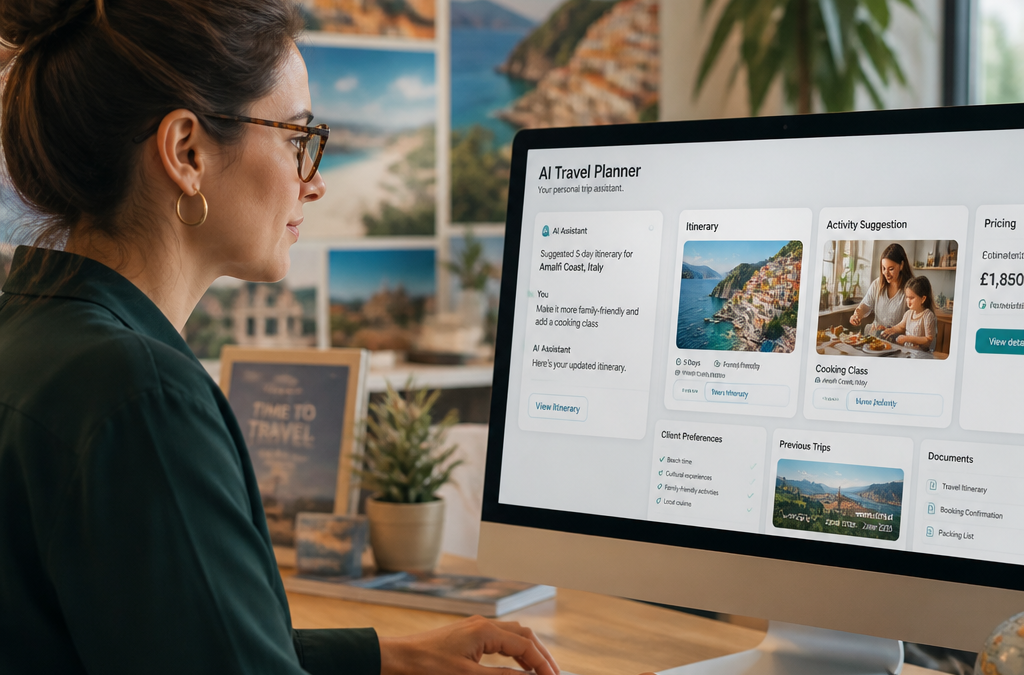
The Go There Travel AI Travel Planner was built on this principle: the human touch, supercharged. Feed it an enquiry and it returns destination options, realistic pricing ranges and a draft itinerary. Everything is shaped around the client’s budget, dates and travel style.
Unlike a generic chatbot, it is built specifically for travel agents and the way they package and price trips. For more on that difference, read From Generic Chatbot to Trusted Expert.
What You Still Do
You sense-check every suggestion against your own knowledge. You add the hotel you personally visited last year. You present it in your voice.
Clients never see a robot. They see an agent who came back faster, with better options, than anyone else they asked.
Stage 1: Qualifying the First Enquiry
AI itinerary planning is only as good as the brief you give it. Capture budget, dates, party make-up, departure airport and any dealbreakers before you run anything.
A simple brief template does this in two minutes. It also tells you early whether an enquiry is serious, so you spend your time where it is most likely to pay.
Stage 2: AI Holiday Pricing Research, From Hours to Minutes
AI holiday pricing research is where most agents see the fastest payback. Instead of checking supplier portals for every option, ask for indicative pricing across several destinations at once. Then verify only the shortlist with your suppliers.
The key word is indicative. AI gives you a realistic range to frame the conversation early. For example: “Mauritius will sit around £5,500 for your dates, the Canaries nearer £3,200.”
The client self-qualifies before you invest serious time. You still confirm live rates before quoting. The win is that you stop doing deep pricing work on enquiries that were never going to fit the budget.
Stage 3: AI Itinerary Planning That Still Sounds Like You
Use the AI draft as a skeleton, not a finished product. Add your own recommendations, a personal anecdote and your agency branding.
This is also where you can go beyond the flight and hotel. Restaurant tips, transfers and local experiences are what make a proposal feel expert. Our guide Beyond Flights and Hotels shows how to add in-resort recommendations that clients remember.
Stage 4: Booking and Pre-Departure
Never quote directly from AI output. Confirm live pricing and availability with suppliers before the client sees a final figure.
Once booked, AI can draft the routine messages that eat into your evenings: payment reminders, document checklists and countdown notes. You review and send. The client feels looked after, and you are not writing the same email for the hundredth time.
Stage 5: Aftercare and Repeat Bookings
This is where AI quietly earns its keep. Most agents know they should follow up after every trip. Few manage it consistently, because follow-up relies on memory and spare time.
AI changes that. Log preferences from every trip: the room type they loved, the excursion they skipped, the anniversary in May. The tool then prompts you with timely, personal follow-ups.
- A welcome-home message two days after they land, asking how it went.
- An anniversary reminder six weeks before the date, with one tailored idea.
- A “your favourite resort has availability for half term” note when it matters.
You stay the human voice. The AI simply makes sure no client slips through the cracks. That is how one booking becomes a client for life, and a source of referrals.
Your AI Enquiry Workflow at a Glance
- Capture the enquiry in full: budget, dates, party, airport and dealbreakers.
- Generate two or three destination options, each with a pricing range rather than a single figure.
- Sense-check with your own expertise. Remove anything that clashes with what you know, such as a resort with building works.
- Draft the itinerary and personalise it with your own recommendations and branding.
- Verify live pricing and availability with suppliers before anything reaches the client.
- Log preferences and key dates so post-trip and anniversary follow-ups happen automatically.
What to Watch Out For
- Quoting AI-generated prices as final figures. Indicative ranges are for qualifying, not booking.
- Generic AI tools inventing hotels, flight routes or visa rules. Use travel-specific tools and check anything you have not verified yourself.
- Sending AI drafts to clients unedited. If it does not sound like you, your clients will notice.
- Putting client personal data into free consumer AI tools, which may store or train on it. The ICO’s guidance on AI and data protection sets out what UK businesses need to consider.
- Automating so much that follow-ups feel robotic. Templates should prompt you, not replace you.
Quick Checklist
- Pick one live enquiry this week and run it through an AI planner alongside your normal process. Compare the time spent.
- Write a standard brief template covering budget, dates, party, airport and dealbreakers.
- Set your verification rule: no AI-sourced price reaches a client without supplier confirmation.
- Set up post-trip follow-up prompts for your last ten returning clients.
- Check the data policy of any AI tool before entering client names or details.
- Note your current average response time to new enquiries, so you can measure the improvement.
FAQ:
Q: Will AI replace travel agents?
A: No. AI is taking over the research and admin, not the judgement, relationships and accountability that clients pay for. The real risk is not AI itself. It is a competitor using it well and replying faster than you.
Q: What AI tools should a travel agent start with?
A: Start with one travel-specific tool rather than a stack of general ones. A purpose-built planner such as the Go There Travel AI Travel Planner handles enquiry qualification, pricing research and itinerary drafting in one place. Add general writing tools later if you need them for marketing.
Q: Is it safe to put client details into AI tools?
A: Only if the tool commits to not storing or training on your client data. Most free consumer tools do not. Check for UK GDPR compliance and a clear data processing agreement before entering names, passport details or payment information.
Q: How much time can AI actually save a travel agent?
A: It depends on how complex your enquiries are. The biggest savings come from pricing research and itinerary drafting, where hours of manual checking can shrink to minutes. The bigger commercial gain is speed to first response, because the first credible reply usually wins.
Q: Can AI help travel agents win repeat bookings?
A: Yes. AI can log each client’s preferences and key dates, then prompt you with timely follow-ups such as anniversary ideas or resort availability. You stay the human voice; the AI makes sure nobody is forgotten.
You already know where your week goes. The question is whether you keep giving away hours of unpaid research, or make this the quarter you win them back.
The agents pulling ahead are not debating AI any more. They are replying to enquiries in minutes, with polished and personal options, and staying in touch long after the client gets home.
The gap between agents who adopt travel-specific AI now and those who wait will show up in conversion rates and repeat bookings. The only sensible way to decide is to test it on a real enquiry and judge the result yourself.
Bring us your trickiest current enquiry and see the Go There Travel AI Travel Planner turn it into a priced, personalised draft within a single 15-minute demo. Book your free slot at gotheretravel.com/book-a-demo.