
It is nine o’clock on a Friday night.
The email is from a client you booked back in March. They fly to Albufeira on Saturday, they have two teenagers who will not touch fish, and they want to know where to eat. You are now three clicks into a review site, reading posts from 2022 and cross-checking opening hours on a Facebook page nobody has updated since 2023.
Here is the shortcut. Travel agents can answer that email in two minutes by working from in-resort restaurant recommendations that already sit inside the booking process, rather than researching every request from scratch.
The rest of this post covers why that question keeps landing in your inbox, how the answer gets built into the booking, and a six-step process you can put into your workflow this week.
Who This Is For
This is written for independent travel agents, homeworkers and small agency owners selling packages, beach holidays, city breaks and multi-centre trips to leisure clients.
You may be a member of a consortium, running a shop on a high street, or working from a spare room with a phone and two screens. Your bookings come largely from repeat clients and referrals, which means your reputation lives or dies on the detail.
You are competing with online travel agents on price and losing patience with it, so you compete on service instead. Restaurant questions, transfer questions and “where should we go on the Tuesday” questions all land in your inbox because clients trust you more than a search engine.
The Late-Night Google Problem Every Agent Recognises
The awkward part of selling a holiday is the question that arrives after the money has been taken.
It is never the booking that eats the evening. It is the follow-up. Agents tell us the same thing every time: the booking earns the commission, the extras earn the loyalty, and the extras take unpaid hours nobody quotes for.
The booking earns the commission. The extras earn the loyalty. And the extras take unpaid hours nobody quotes for.
There is a risk sitting underneath the inconvenience, too. When you have not personally visited the resort, you are recommending on faith. One closed restaurant, one badly judged suggestion, and a lot of goodwill quietly disappears.
The same applies in cities, where the stakes are subtler and the mistakes are easier to make. A client on a three-night break in Seville does not want the square with the laminated menus, and if you send them there once, they will book their next city break themselves.
Still weighing up whether this is a real problem or just an occasional nuisance? Add up the evenings you spent on client questions last month, then look at what that time was worth.
If the number surprises you, spend fifteen minutes with us instead: book a walkthrough of Go There Travel and bring a live enquiry with you.
How Go There Travel Builds In-Resort Restaurant Recommendations Into the Booking
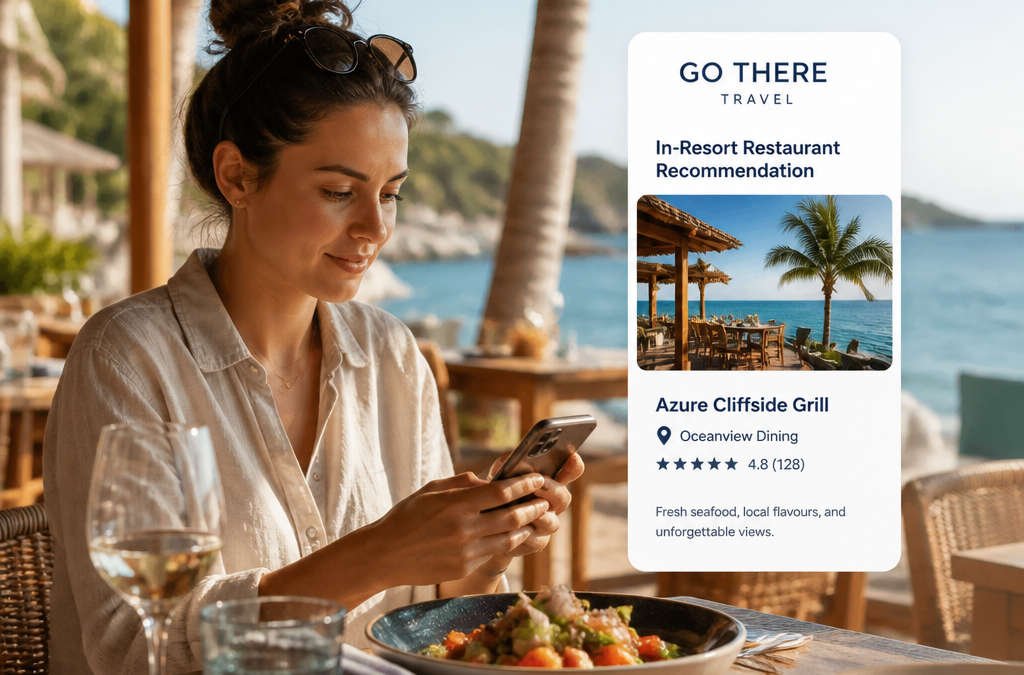
Go There Travel treats in-resort restaurant recommendations as part of the product, not an afterthought.
When you search a destination and accommodation, you also get curated local dining recommendations for that resort. They are organised by the things clients actually ask about: family-friendly, walkable from the main hotel strip, good for a special occasion, genuinely local rather than tourist-facing, and options for guests who need gluten-free or halal choices. You can see how this sits alongside resort information on gothere.travel.
Every entry is written in plain English, with the practical detail you need to answer confidently.
That means a rough price bracket, walking distance from the resort centre, whether booking ahead is advisable in high season, and the kind of dish the place is known for. Copy a shortlist into your pre-departure email in under a minute, add your own notes, and send it under your own name.
The point is not to turn you into a food critic. It is to make sure that when a client asks, you already have the answer, and it is a good one.
Why Added-Value Travel Booking Beats Competing on Price
Added-value travel booking works because dinner is what clients remember.
Nobody comes home and raves about a seat allocation. They will tell four friends about the tiny place off the square where the owner brought out extra dessert. When that recommendation came from you, the referral comes back to you as well.
There is a commercial argument underneath the sentiment.
Agents who send a curated dining shortlist before departure create a natural reason to make contact again, and that is the same touchpoint that surfaces upgrades, excursions, transfers and next year’s booking.
It also gives you something concrete to say in your marketing. “I book the holiday and tell you where to eat” is a far sharper pitch than “great service, competitive prices”, and it is a promise an online travel agent cannot credibly copy.
Step by Step: Adding Dining Recommendations to Your Client Service
- Ask two dining questions at the research stage. Find out how the group likes to eat, whether that is self-catering with a few nights out or dinner every evening, and note any dietary requirements. Record both against the booking.
- Pull the destination dining content when you confirm the itinerary. Search the resort or city in Go There Travel and review the local dining recommendations for that area alongside the accommodation you have just sold.
- Build a shortlist of four to six places, not twenty. Cover one family option, one special-occasion option, one walkable everyday option and one genuinely local find. For a city break, swap the family option for one near the main sights and one in the neighbourhood the client is actually staying in. Choice is helpful, overload is not.
- Send it as a branded pre-departure email around ten days before travel. Add a line explaining why you picked each one for them specifically, which is what turns a list into advice.
- Flag anything that needs booking ahead. High-season tables in popular resorts go quickly, and warning clients in advance saves a disappointed message from the pavement outside.
- Ask for feedback on return. Note what landed well and feed it back, so your recommendations sharpen with every booking you make.
What to Watch Out For
- Sending a long unfiltered list. Twenty restaurants reads like a search result, not expertise. Four well-chosen options with a reason attached carry far more weight.
- Ignoring dietary needs you already know about. Recommending a seafood specialist to a vegetarian family undermines everything else you have done well.
- Forgetting seasonality. Plenty of resort restaurants close outside the main season or shift to reduced hours, so check before you promise.
- Presenting recommendations as guarantees. Frame them as suggestions based on current information and encourage clients to ring ahead.
- Doing the work and not claiming the credit. If you send the shortlist without your branding on it, the goodwill drifts.
Quick Checklist
- Add two dining questions to your standard enquiry form or call script.
- Save a reusable pre-departure email template with space for a dining section.
- Check the destination dining content in Go There Travel before you send any confirmation.
- Limit each shortlist to four to six places with one sentence of reasoning each.
- Note dietary requirements against the booking, not in your head.
- Mark which venues need advance reservations in peak weeks.
- Include your name, agency and contact details on every shortlist you send.
- Log client feedback after return so your next recommendation is stronger.
Frequently Asked Questions
How can a travel agent recommend restaurants in a resort they have never visited?
Use curated destination content rather than open web searches. Go There Travel provides in-resort restaurant recommendations tied to the resorts you sell, including price bracket, distance from the centre and what the venue is known for, so you can advise confidently without having eaten there yourself. Always present suggestions as recommendations and encourage clients to book ahead in high season.
Is it worth offering dining recommendations if I do not earn commission on them?
Yes, because the return arrives through retention rather than the transaction. A dining shortlist creates a pre-departure touchpoint that often leads to transfers, excursions or upgrades, and it gives clients a specific reason to recommend you. It is one of the cheapest forms of differentiation available to a small agency.
When is the best time to send restaurant suggestions to clients?
Around seven to ten days before departure works best. Clients are packing, planning and receptive, and there is still time to reserve tables for the nights that matter. Sending at the point of booking is usually too early, because the information gets buried and forgotten.
What makes a good in-resort dining recommendation for a family booking?
Practicality first. Look for walkable distance from the accommodation, early service times, a menu with recognisable options for children, and outdoor space where possible. One reliable everyday option matters more to families than a highly rated restaurant twenty minutes away by taxi.
Does dining advice work the same way for city breaks as for beach resorts?
The principle holds but the shortlist changes shape. City clients move around more, so pick by neighbourhood rather than by distance from one hotel, include one option near the main sights for the day they are out walking, and add one that is worth booking. Two or three well-placed suggestions usually beat six scattered across a city.
Does offering extras like dining advice slow down the booking process?
It should not. If the destination content sits in the same platform where you search flights and accommodation, building a shortlist takes a couple of minutes rather than an evening, which is exactly how a comprehensive travel agent service should work in practice.
You already answer the restaurant question.
The only decision is whether you keep answering it at nine on a Friday night from a review site, or whether you answer it in two minutes from content built around the resorts and cities you sell. Agents who make that switch tend to notice the same two things: fewer unpaid hours, and clients who come back because someone clearly thought about their holiday properly.
Look at your last five bookings and ask which of those clients would have valued a dining shortlist.
Fifteen minutes is enough to see whether this fits how you work. Grab a demo slot with the Go There Travel team and we will search a live destination with you, dining content included.