
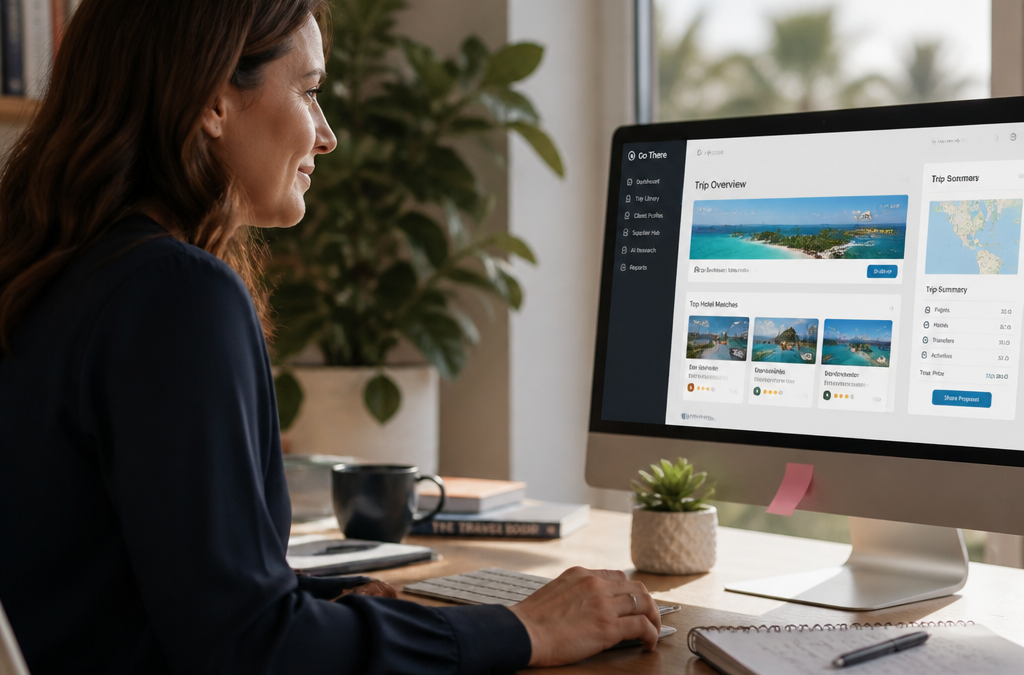
You reduce holiday research time by fixing the order you work in, not by reading faster. Most agents lose hours because research begins before the brief is tight, so every supplier site, review page and flight search is answered with guesswork. A structured travel agent research workflow flips that: qualify first, define non-negotiables, then run one AI-assisted search across properties, regions and routings, and only open a supplier portal once the shortlist is down to three. Agents using Go There Travel this way typically cut a two-hour quote build to under forty minutes, because the tool does the comparison legwork while you stay the expert who interprets it. The rest of this guide sets out that workflow step by step, including where it breaks and how to protect it during peaks.
Who This Is For
This guide is written for travel agents who build bespoke itineraries by hand. That includes homeworkers with a consortium, independent agency owners running a small team, and multi-branch consultants handling tailor-made long haul alongside package sales. You are probably juggling twenty to forty live enquiries, quoting into the evening, and covering weekend enquiries yourself. Your product knowledge is genuinely deep in three or four destinations and thinner everywhere else, which is exactly where research swallows time. If your conversion rate is healthy but your hourly return is not, and January peaks feel like triage rather than selling, this workflow is aimed at you.
The Real Problem Is Unpaid Research, Not Slow Typing
The time drain is research you never get paid for. An enquiry lands for a fortnight in Vietnam with two teenagers, you spend ninety minutes cross-referencing hotels, sailing schedules and internal flights, and the client goes quiet. Agents describe it the same way every time: twelve tabs open, three supplier portals, a half-built spreadsheet, and quoting at nine at night because the day went on phone calls. The cost is not just hours. It is the enquiry you deprioritised because the complex one ate the afternoon, and the second option you never built because there was no time left.
See the workflow applied to one of your own live enquiries on a screen share. Book a 15-minute demo with Go There Travel and bring a brief you are stuck on.
How Go There Travel Helps You Reduce Holiday Research Time
Go There Travel is an AI travel research tool built around the way agents actually scope a trip, which is why it shortens the front end rather than the admin end. You enter the brief in normal language, including budget, dates, travel style, must-haves and dealbreakers, and it returns matched properties, sensible routings and region combinations with the reasoning shown. Because the reasoning is visible, you can challenge it. That matters more than raw speed.
The design principle is simple: research in minutes, not evenings, with the agent still making the call. The tool does not book, it does not talk to your client, and it does not pretend to know your repeat guest’s preference for a ground-floor room. It removes the comparison grind that stands between an enquiry and a shortlist, so you reduce holiday research time without handing judgement to a machine. Full detail on what the platform does and does not do sits on the Go There Travel features page.
Faster Holiday Planning Depends on Brief Quality
A weak brief guarantees slow research, whatever tool you use. Faster holiday planning starts at the qualification call, where four answers do most of the work: realistic total budget including flights, pace of trip, deal-breakers, and who the trip is really for. Ask what they disliked about their last holiday, not just what they enjoyed. The negative answer narrows options faster than the positive one.
Write the brief once, in one place, in full sentences. Agents who feed a complete brief into an AI travel research tool get usable shortlists on the first pass roughly eight times in ten. Agents who feed three bullet points end up running four searches and blaming the technology. The bottleneck is nearly always upstream.
Step by Step: The Forty-Minute Quote Build
- Qualify before you research. Spend fifteen minutes on the call capturing budget, dates, pace, deal-breakers and the reason for the trip. Do not open a browser during this call.
- Write the brief in full sentences. Include anything that rules an option out, such as no long internal flights, no adults-only, or must be walkable from a beach. Constraints are what make the search fast.
- Run one AI-assisted search. Paste the brief into Go There Travel and review the matched properties, routings and regional pairings, checking the reasoning against your own knowledge of the destination.
- Cut to three options, fast. Reject anything that fails a deal-breaker within the first two minutes. Resist building a fourth option to look thorough. Three costed options convert better than five vague ones.
- Verify commercials in the supplier portal. Only now open your operator or DMC systems to confirm live availability, contracted rates and commission. This is the one stage that should not be rushed.
- Present with a recommendation. Lead with the option you would book yourself and say why. Send it within twenty-four hours of the call.
What to Watch Out For
- Treating AI output as verified availability. It is a research shortlist, not a live inventory feed. Always confirm in the supplier system before you quote a price.
- Researching before qualifying. This is the single biggest cause of wasted hours and it survives every new tool you adopt.
- Over-building for cold enquiries. Give a two-line direction of travel first and build properly once the client engages.
- Ignoring your own destination expertise. If the shortlist looks wrong for the season or the family’s pace, override it and note why.
- Letting the workflow lapse during peaks, precisely when the time saving is worth most.
Quick Checklist
- Block two research windows a day rather than dipping in between calls.
- Use one standard brief template for every enquiry, no exceptions.
- Capture at least two deal-breakers on every qualification call.
- Cap first-pass research at twenty minutes per enquiry and stop when the timer goes.
- Shortlist three options maximum before opening any supplier portal.
- Log how long each quote takes for two weeks so you can see the change.
- Save reusable itinerary skeletons for your five most-quoted destinations.
- Review one AI-generated shortlist against a trip you have already sold, to calibrate your trust in it.
FAQ
How can travel agents reduce holiday research time without cutting corners?
Move the effort earlier. A thorough qualification call and a written brief let you run one focused search instead of four exploratory ones, which protects quality while removing repetition. The corner-cutting risk comes from skipping supplier verification, not from using AI to build the shortlist.
Is an AI travel research tool accurate enough to quote from?
Not on its own, and it should not claim to be. Use it to identify and compare options, then confirm availability, contracted rates and commission in your operator or DMC system before anything goes to the client. Go There Travel shows its reasoning specifically so you can sense-check matches against your own destination knowledge.
How long should a bespoke itinerary quote take to build?
Around forty minutes for a mainstream long-haul trip once the workflow is embedded, and up to ninety for a complex multi-country itinerary with unusual routings. If routine quotes are still taking two hours, the problem is almost always an incomplete brief rather than slow research.
Will using AI make my service feel less personal to clients?
No, provided you keep the client-facing work. Clients respond to the recommendation, the reasoning and the local detail you add, none of which the tool produces for them. Agents generally report more time for the personal touches, because the comparison grind is what gets removed.
CONCLUSION
You already know which enquiries are eating your week. The decision is whether to keep absorbing that as the cost of doing tailor-made, or to change the order you work in before peaks arrive. Try the workflow manually on your next three enquiries and time yourself. If the brief stage alone saves you thirty minutes a quote, the tooling will compound it. If you would rather see it working on a real brief before changing anything, spend a quarter of an hour with us and judge it on your own enquiry.
Bring one live, awkward enquiry to a 15-minute demo and we will build the shortlist with you.
Choose a slot on the Go There Travel demo booking page.