
2026 is set to be the start of a new golden era for travel agents, but only for those who combine high tech & human touch.
Guest post by Ronnie Findlay, AI Educator and Travel Industry Veteran
I spent almost three decades in the travel industry, and I can tell you with absolute certainty: we’re standing at the edge of the most significant transformation the industry has ever seen. And here’s the twist that most people aren’t talking about – it’s not going to make travel agents obsolete. Quite the opposite. 2026 is set to usher in a golden age for travel professionals. But only for those who understand what’s really happening with the knowledge gap between customers and agents.
The AI Story Nobody Expected
Let me share something that might surprise you. Over the past year, as I’ve educated CEO’s and sales and marketing teams on AI adoption across various industries, I’ve witnessed a fascinating paradox emerge in travel: the more AI tools become available to consumers, the more overwhelmed they become, and the more they crave human connection and expertise.
Think about it. Your customers can now ask ChatGPT to plan their holiday. They can scroll through infinite Instagram reels of destinations. They have access to more review sites, comparison tools, and travel blogs than ever before. And what’s happening? They’re drowning in choice. Analysis paralysis has become epidemic.
This is where Travel Agents come in, but in a way that balances the knowledge gap between you and the customer.
The 2026 Landscape: What’s Actually Changing
By mid-2026, we’ll see several seismic shifts in how travel is distributed and sold:
AI-savvy customers will be the norm, not the exception. Your clients will arrive having already “researched” their trip using AI tools. They’ll have itineraries, price comparisons, and a head full of possibilities. But here’s the catch – they’ll have no idea if any of it actually works for them.
Product complexity will exponentially increase. As suppliers scramble to differentiate in an AI-searchable world, the number of options, packages, and permutations will explode. The “perfect match” will be harder to find, not easier.
The trust economy will dominate. When everyone has access to the same AI tools, trust becomes the ultimate differentiator. And trust, my friends, is built through human connection and proven expertise.
Why Travel Agents Will Thrive (But Only the Right Ones)
Here’s what I learned from almost thirty years in the travel business: customers don’t just buy holidays. They buy confidence. They buy the certainty that they’re making the right decision for one of their most important purchases of the year.
And no AI chatbot, however sophisticated, can provide what you provide: understanding the unspoken needs, reading between the lines of a brief, knowing that when someone says “relaxing” they might mean a spa resort or they might mean white-water rafting, depending on who they are.
But, and this is crucial, you can’t compete with AI using 1995 methods. You can’t spend three hours manually researching options that an AI could surface in three minutes. You can’t afford to miss the perfect product because it’s in a supplier system you didn’t have time to check. Or you are restricted by a supplier sales policy that doesn’t offer experiential travel products, which are increasingly popular.
This is where the winners and losers will be decided in 2026.
The Productivity Revolution You Can’t Ignore
I’ve watched brilliant travel agents – people with decades of experience and genuine passion – struggle to keep up with enquiry volumes. Not because they lack expertise, but because they’re spending 80% of their time on research and only 20% on what they do best: connecting with customers and applying their wisdom.
It’s backwards. And it’s unsustainable.
The agents who will dominate in 2026 understand this: AI isn’t your replacement, it’s your research assistant, your product matcher, and your productivity multiplier. It handles the grunt work – the searching, the filtering, the initial matching – so you can focus entirely on the human elements that no algorithm can replicate.
When I’m training teams on AI adoption, I always say: “AI should do what computers do best, so humans can do what humans do best.” That’s not a slogan. That’s a survival strategy.
The ASTRA Advantage: Built for the Real World
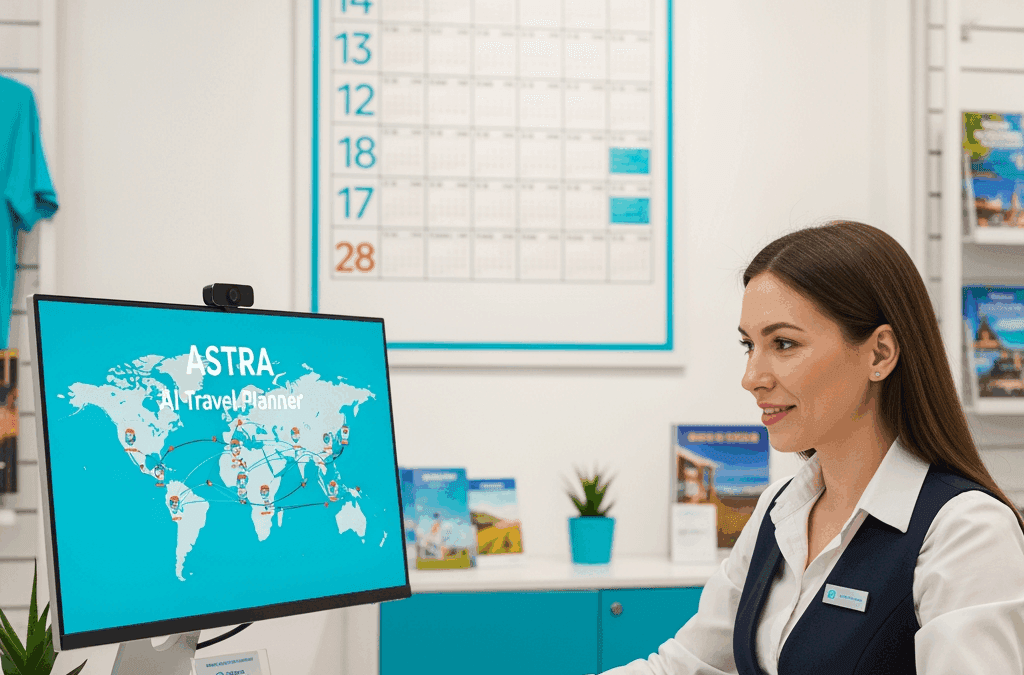
This is why Go There Travel’s ASTRA AI Travel Planner isn’t just another tool – it’s a fundamental shift in how travel agents operate. And I’m not saying this as a salesperson. I’m saying this as someone who’s evaluated dozens of AI solutions across industries and understands what actually works.
ASTRA does three things that directly address the 2026 challenge:
First, it eliminates research time that doesn’t add value. When a customer sends you a brief – even a challenging one – ASTRA can search for the perfect product match, understand nuanced requirements, and surface genuinely relevant options in minutes. That’s not three hours of your time. That’s not “close enough” products. That’s precision-matched options ready for your expert evaluation.
Second, it increases your conversion rate. Here’s the truth: customers can sense when you’ve found their perfect holiday versus when you’ve found something that’s “pretty close”. ASTRA’s ability to match even the most complex briefs means you’re presenting solutions that genuinely resonate. And when customers feel understood, they book. It’s that simple.
Third, it builds loyalty that lasts. When you consistently deliver exactly what customers need – not just once, but every time – you’re not just winning transactions. You’re winning lifetime relationships. In 2026, when customers have infinite options, they’ll return to the agent who truly gets them. Every single time.
The Human Touch in a Digital Age
Here’s what keeps me excited about this industry: the more digital everything becomes, the more valuable a genuine human connection becomes.
Your customers aren’t looking for a search engine. They’ve got those. They’re looking for someone who can take their jumbled thoughts, unspoken anxieties, and half-formed dreams and turn them into a tangible experience they’ll treasure forever.
They need someone who understands that “family-friendly” means something completely different to a family with toddlers than it does to one with teenagers. Someone who understands that “adventure” might need to be balanced with accessibility for an elderly parent they haven’t mentioned yet. Someone who can spot the red flags in a “too good to be true” deal they’ve found online.
That’s you. That’s your expertise. That’s your irreplaceable value.
But in 2026, you need AI to free up your time to deliver it.
The Question You Need to Ask
As we move deeper into 2025 and towards 2026, every travel agent needs to ask themselves one honest question: “Am I spending my time on what I’m uniquely brilliant at, or am I spending it on tasks that technology could handle better?”
If you’re still manually trawling through supplier websites, copying and pasting into spreadsheets, and trying to remember which operator does that specific type of villa in that particular region, you’re not competing with AI. You’re competing with one hand tied behind your back, whilst your competitors have both hands free.
The agents who will thrive in this golden age understand something fundamental: technology doesn’t diminish expertise. Used correctly, it amplifies it. It takes your three decades of knowledge and makes it accessible at the speed of thought. It takes your understanding of human nature and pairs it with perfect product matching.
The Golden Age Awaits
I’m genuinely excited about what’s coming. Not apprehensive. Not worried. Excited.
Because for the first time in my career, we have tools that can match the speed of customer expectations without sacrificing the depth of human expertise. We can handle challenging briefs with confidence. We can deliver personalised service at scale. We can spend our time building relationships instead of building spreadsheets.
But this golden age isn’t automatic. It belongs to those who adapt. To those who recognise that the future of travel isn’t AI versus human – it’s AI empowering human.
2026 is going to separate the travel agents who understand this from those who don’t. The productivity gap will become a chasm. The conversion rate differential will become stark. The loyalty divide will become permanent.
The question is: which side of that divide will you be on?
Welcome to the golden age. Let’s make it golden together.
Ronnie Findlay is an AI educator specialising in sales and marketing applications, with nearly thirty years of experience in the travel industry. He works with businesses across sectors to leverage AI effectively whilst maintaining the human elements that drive real connection and conversion.